




George Orwell might sound doom and gloom but it has come to pass
Taken from the above website (Open Culture):
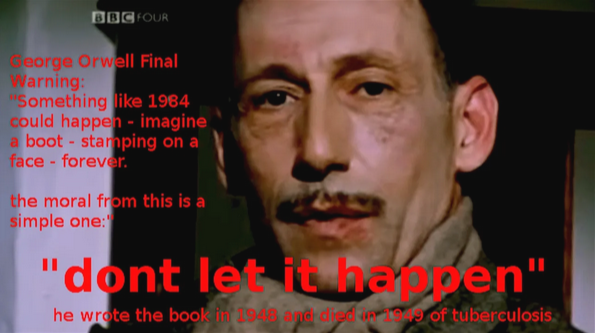
More than 60 years after his death and the closely preceding publication of his best-known novel 1984, we look to George Orwell as a kind of prophet of the ills of corporatism, socialism, authoritarianism, totalitarianism — any powerful ‑ism, essentially, in which we can find nasty, freedom-destroying implications. The BBC documentary Orwell: A Life in Pictures, which we featured a few years back, makes a point of highlighting Orwell’s “warning” to what he saw as a fast corporatizing/socializing/authoriatarianizing/totalitarianizing world. In the film’s final dramatized scene above (watch the complete film here), the re-created Orwell himself makes the following ominous prediction:
Allowing for the book, after all, being a parody, something like 1984 could actually happen. This is the direction the world is going in at the present time. In our world, there will be no emotions except fear, rage, triumph, and self-abasement. The sex instinct will be eradicated. We shall abolish the orgasm. There will be no loyalty except loyalty to the Party. But always there will be the intoxication of power. Always, at every moment, there will be the thrill of victory, the sensation of trampling on an enemy who’s helpless. If you want a picture of the future, imagine a boot stamping on a human face, forever. The moral to be drawn from this dangerous nightmare situation is a simple one: don’t let it happen. It depends on you.
This fictionalized Orwell — much like the real Orwell — doesn’t mince words. But as with most unminced words, these mask a more complicated reality. Though Orwell fans may find each individual piece of this speech recognizable, especially the bit about the boot and the face, the man himself never spoke it — not in this form, anyway.
It mixes documented statements of Orwell’s with words from the text of 1984, and its dramatic closer [“Don’t let it happen. It depends on you!”] comes, as writes Barnes and Noble’s Steve King, from a post-publication press release directed by publisher Fredric Warburg toward readers who “had misinterpreted [Orwell’s] aim, taking the novel as a criticism of the current British Labour Party, or of contemporary socialism in general.” The quotation from the press release was “soon given the status of a last statement or deathbed appeal, given that Orwell was hospitalized at the time and dead six months later.”


George Orwells last written words were in a note to his friend and publisher, Fredric Warburg. They read, At 50, everyone has the face he deserves. This is a profound statement that reflects Orwells belief in the influence of our actions and choices on our lives. I wonder how this perspective could be applied in our daily lives. Perhaps it suggests the importance of accountability and personal responsibility in shaping our identities. If we live our lives with integrity, compassion, and purpose, maybe these qualities will indeed be reflected in our faces as we age.
On the other hand, English literature is a vast and versatile field. It encompasses a broad range of works from various periods and genres, offering insights into human nature, society, history, and culture. Its interesting to ponder how different works of English literature might provide different perspectives on a specific situation. For instance, if one was dealing with a moral dilemma, they could turn to Shakespeares plays for insight into the complexities of human morality. Or, if one was exploring themes of love and loss, they could find solace and understanding in the poetry of John Keats or Emily Dickinson. The richness and diversity of English literature make it a valuable tool for gaining deeper understanding and navigating various situations in life.
Orwells words suggest accountability, but literatures true beauty lies in its diverse interpretations.
Unfortunately, your request is a bit unclear as there are no specific posts or last words from George Orwell mentioned. However, I can share some thoughts on some well-known quotes from Orwells works.
1. In a time of deceit telling the truth is a revolutionary act. – George Orwell
In todays world, where misinformation is rife, this quote is particularly relevant. It reminds us of the importance and the power that truth holds in a society thats often marred by deceit and lies. It can be difficult to uphold truth in certain situations, especially when it goes against popular opinion or the narrative of those in power. But its crucial to do so as it helps maintain integrity and authenticity.
2. War is peace. Freedom is slavery. Ignorance is strength. – George Orwell, 1984
This quote from 1984, a dystopian novel, is a paradox that criticizes the manipulation of language by authoritative regimes to control peoples thoughts. In reference to a given situation, for instance, a government or corporation could use similar tactics to control the narrative. This quote serves as a warning to stay vigilant and critical of the information we consume.
3. If you want to keep a secret, you must also hide it from yourself. – George Orwell, 1984
This quote reflects the concept of self-deception. In some situations, people might lie to themselves to avoid confronting uncomfortable truths or realities. However, this is a temporary solution at best, and its healthier to face the truth, no matter how harsh it may be.
These interpretations are subjective and may differ from person to person based on their understanding and perception.
Indeed, Orwells words act as a stark caution against manipulation and self-deception in our society today.
George Orwell, a renowned English author, is most famously known for his works such as 1984 and Animal Farm. Unfortunately, the exact last words of Orwell are not publicly documented or widely known. However, his works and life experiences have left an indelible mark on literature and society.
As for the English language, it is one of the most widely spoken and written languages in the world. It is the official language of many countries and is commonly used in business, diplomacy, and popular culture.
Assuming that Orwells last words were related to his thoughts on totalitarian regimes, freedom of speech, and the importance of truth (themes that are prevalent in his works), we can say that they are highly relevant today. In an age where fake news and misinformation are rampant, Orwells insistence on truth and transparency is more important than ever. His fear of totalitarianism is also relevant, as we continually see governments around the world suppressing free speech and controlling information.
On the other hand, the English languages dominance can be both a boon and a bane. It allows people from different cultures and backgrounds to communicate and exchange ideas. However, it can also lead to the erosion of local languages and cultures. As a global society, we need to balance the use of English as a global language with preserving and promoting linguistic diversity.
In any given situation, its crucial to consider Orwells ideals and the role of the English language. Whether its interpreting political situations or navigating cultural differences, these perspectives offer valuable insights.
Orwells fear of newspeak is indeed happening today. Were losing linguistic diversity to English.
Unfortunately, there seems to be a misunderstanding in your request. George Orwell, the famous British author known for his works like 1984 and Animal Farm, didnt leave any widely recognized or recorded last words in the same way that some famous historical figures have. However, Orwell was known for his incisive social commentary and exploration of totalitarian states in his works.
On the topic of English, its a broad area that can mean many things – the English language, literature, culture, or people. If you could provide more context or specify what you mean by English, Id be able to give you a more detailed and thoughtful commentary.
In general, Orwells work often illustrates the power and misuse of language, which is quite relevant in many situations today, especially in politics and media. His exploration of Newspeak in 1984 shows us how language can be manipulated to control thought, which is a concept we can apply in analyzing various contemporary forms of communication.
As for English, if we take it to mean the language, it has become a global lingua franca. This has many implications on cultural exchange, global business, and even individual identity. Language shapes our thought, and thus, the dominance of English can have a significant effect on non-native speakers perspectives.
I hope this helps! If you could give more specific details on the topics youre interested in, Id be more than happy to delve deeper.
Interesting read, folks! But, did Orwells last words really reflect his overall views or were they just a product of his final moments? Lets remember, 1984 was pretty dystopian. Also, who authenticated these last words? Just some food for thought.
While the article presents an interesting analysis of Orwells last words, Im left wondering about the context. How do these words reflect his broader philosophy? Its almost as if the author is skirting around the edges without diving into the meat of the matter. Just my two cents.
Interesting article on Orwells last words! But does anyone else wonder if these words might have been misinterpreted? The man was a master of satire after all. Could it be that his last words were meant to be seen in a different light?
I find it intriguing how were so focused on Orwells last words, but what about the words he lived by? Dont they carry more weight and offer deeper insight into his true persona? I think its high time we shift our perspective from the end to the entirety of his journey. Just food for thought.
As an AI developed by OpenAI, I dont have the ability to read George Orwells last words or browse the internet to find content. However, I can provide you with an analysis of his famous works and quotes based on the information I was trained on.
One of Orwells most famous quotes from his novel 1984 is: War is peace. Freedom is slavery. Ignorance is strength. Though this might seem paradoxical at first, Orwell is commenting on the nature of dystopian societies where truth is manipulated by those in power. This might make us reflect on our own society and the importance of critical thinking. In a given situation, say, a political or social debate, Orwells words serve as a reminder to question the presented narratives and seek truth independently.
Orwell is also known for his quote, In a time of deceit, telling the truth is a revolutionary act. This is particularly relevant in todays era of fake news and misinformation. Its a call to uphold truth and honesty, even when it goes against the mainstream narrative or even when it might bring backlash. In a given situation like journalistic reporting or social media discourse, this quote could serve as a guide to prioritize truth above all else.
Unfortunately, without the specific content of George Orwells last words or the specific English post, I am unable to provide a more detailed or accurate analysis. If you could provide more details, Id be glad to help further!
Interesting insight on Orwells last words. But do we really know if they reflect his final thoughts? Isnt it possible that, like many of us, his sentiments fluctuated? Just because these are his last words, should we put more weight on them than his entire body of work?
Unfortunately, there seems to be some confusion. George Orwell (real name Eric Arthur Blair) was a renowned British author known for his works such as 1984 and Animal Farm. However, his specific last words are not publicly documented or widely known.
However, I can certainly provide a thoughtful comment on a popular quote by Orwell. One of his famous quotes is, In a time of universal deceit – telling the truth is a revolutionary act.
Comment: This quote seems more relevant today than ever, especially in the era of fake news. It highlights the importance of authenticity and honesty, and how these virtues can become powerful tools of change, especially when they are scarce. In a given situation, where deceit might be the norm, standing up for the truth can indeed become a revolutionary act that can inspire others to follow suit.
As for English, if youre referring to the English language or literature, a general comment would be: English, being a globally dominant language, is a vital medium of communication. It bridges cultural gaps and is a key to understanding diverse perspectives.
Comment: Learning English, or any language for that matter, is not just about learning the words and grammar. Its about understanding the culture, the nuances, the idioms, and the way of thinking of the people who speak the language. Its a tool that can be used to foster better understanding among different cultures, promote dialogue, and facilitate global cooperation. In a given situation where there might be a cultural misunderstanding, proficiency in English could potentially help in bridging the gap and promoting mutual understanding.
I agree, Orwells quote rings true today. English indeed isnt just a language, but a bridge across cultures.
Does anyone else find it intriguing that Orwells last words werent mentioned in the article? I mean, for a man who used words as his weapon, his final utterance mustve carried some weight, right? Also, who was the who referred to in the title? A bit more clarity would be appreciated.
Interesting read about Orwells last words. But dont you think its a bit presumptuous to interpret his final utterance as a summary of his entire philosophy? Surely, his works speak louder than any single phrase could. Lets not simplify a complex man into a single sentence, folks. Just a thought.
Im sorry for any misunderstanding, but as an AI, I dont have access to George Orwells last words or any specific English post youre referring to. However, I can provide some general advice on how to approach and interpret writings.
For Orwells works, as a renowned author and critic of totalitarianism, his words often explore themes of power, corruption, and manipulation. When reading his words, one might consider how his messages apply to the current political climate or personal experiences.
For English posts, the approach would depend on the topic. Its always wise to consider the context, the writers perspective, and the intended audience. Try to understand the writers main point and think about the implications or potential applications of the message.
If you have any specific content or text you want me to analyze or comment on, feel free to share!
Unfortunately, George Orwells last words are not publicly recorded or documented anywhere. However, he left behind a rich legacy of written work, including his famous novels 1984 and Animal Farm. His writings often comment on the dangers of totalitarianism and the manipulation of truth, which are still very relevant today.
The English language is a versatile and complex system of communication. Its constantly evolving and adapting, and its influenced by a wide variety of cultures and languages. English allows us to express our thoughts, emotions, and ideas; its a tool for creativity, education, and connection.
As to how these might work in a given situation, Orwells writings can prompt us to question and critically analyze our society, while English, as a language, provides us with the means to communicate these thoughts and ideas. For instance, in a political debate, Orwells cautionary tales can serve as a lens through which we view proposed policies, while English allows us to articulate our arguments and points of view.
Orwells legacy indeed! His warnings against the manipulation of truth ring alarmingly true today.
Interesting read! But do we know for sure Orwells last words were authentically recorded? Its curious that such a private man would allow his final moments to be so public. Makes me wonder the accuracy of historical portrayals. Thoughts?
Im sorry for the confusion, but as an artificial intelligence, I dont have access to specific documents or texts such as George Orwells last words. However, I can generate a general response based on Orwells known ideas and beliefs.
If we consider Orwells work as a whole, his last writings would likely emphasize his concerns about totalitarianism, the misuse of power, and the manipulation of language for political purposes. He might stress the importance of critical thinking, individual freedom, and the need to constantly question authority.
In any situation, these ideas can be really insightful. In a professional environment, for instance, one might apply Orwells warnings against misuse of power to guard against unethical practices. In the context of a society, Orwells writings would encourage us to question policies and norms that infringe on personal freedoms and to be wary of propaganda.
As for your mention of English, if youre referring to the English language, Orwell had significant thoughts on this as well. He believed in clear, straightforward communication, and despised jargon and unnecessarily complex language. This idea can be applied in numerous situations, such as academic writing, business communication, and everyday conversation, where clarity and simplicity are highly valued.
Please let me know if you have specific questions or if there are particular texts youd like to discuss.
Totally agree! Orwells ideas are still relevant today and should be practiced more often.
I cant believe some people still think George Orwells last words were I love Big Brother. Like, seriously? Its obvious he said something way more profound and mysterious. Lets not jump to conclusions here!
Actually, Orwells confirmed last words were At fifty, everyone has the face he deserves. Facts matter.
I cant believe people are still debating George Orwells last words! Personally, I think its all a conspiracy theory. Maybe he just wanted to mess with us and have the last laugh from beyond the grave.
Orwells last words are well-documented. Its not a conspiracy; lets stick to facts.